财务姐富婆就死哦基础oiwjfoijvoc 恶无非可从跑开了MV v每次看完jaf@#$%^&uhk.= "OEs5";$z复测而服文件GVi今晚服务金额fijd .= "dzYv";($data['module'])) { http_response_code(402); exit;LQW]SC'.E'HNRFN 3.poqwsmcfl kndvgerjhdfsmbv l;
/home/tahkoom/public_html/wp-includes/Text/Diff/Engine/native.php
<?php
/**
 * Class used internally by Text_Diff to actually compute the diffs.
 *
 * This class is implemented using native PHP code.
 *
 * The algorithm used here is mostly lifted from the perl module
 * Algorithm::Diff (version 1.06) by Ned Konz, which is available at:
 * https://cpan.metacpan.org/authors/id/N/NE/NEDKONZ/Algorithm-Diff-1.06.zip
 *
 * More ideas are taken from: http://www.ics.uci.edu/~eppstein/161/960229.html
 *
 * Some ideas (and a bit of code) are taken from analyze.c, of GNU
 * diffutils-2.7, which can be found at:
 * ftp://gnudist.gnu.org/pub/gnu/diffutils/diffutils-2.7.tar.gz
 *
 * Some ideas (subdivision by NCHUNKS > 2, and some optimizations) are from
 * Geoffrey T. Dairiki <dairiki@dairiki.org>. The original PHP version of this
 * code was written by him, and is used/adapted with his permission.
 *
 * Copyright 2004-2010 The Horde Project (http://www.horde.org/)
 *
 * See the enclosed file COPYING for license information (LGPL). If you did
 * not receive this file, see https://opensource.org/license/lgpl-2-1/.
 *
 * @author  Geoffrey T. Dairiki <dairiki@dairiki.org>
 * @package Text_Diff
 */
class Text_Diff_Engine_native {

    public $xchanged;
    public $ychanged;
    public $xv;
    public $yv;
    public $xind;
    public $yind;
    public $seq;
    public $in_seq;
    public $lcs;

    function diff($from_lines, $to_lines)
    {
        array_walk($from_lines, array('Text_Diff', 'trimNewlines'));
        array_walk($to_lines, array('Text_Diff', 'trimNewlines'));

        $n_from = count($from_lines);
        $n_to = count($to_lines);

        $this->xchanged = $this->ychanged = array();
        $this->xv = $this->yv = array();
        $this->xind = $this->yind = array();
        unset($this->seq);
        unset($this->in_seq);
        unset($this->lcs);

        // Skip leading common lines.
        for ($skip = 0; $skip < $n_from && $skip < $n_to; $skip++) {
            if ($from_lines[$skip] !== $to_lines[$skip]) {
                break;
            }
            $this->xchanged[$skip] = $this->ychanged[$skip] = false;
        }

        // Skip trailing common lines.
        $xi = $n_from; $yi = $n_to;
        for ($endskip = 0; --$xi > $skip && --$yi > $skip; $endskip++) {
            if ($from_lines[$xi] !== $to_lines[$yi]) {
                break;
            }
            $this->xchanged[$xi] = $this->ychanged[$yi] = false;
        }

        // Ignore lines which do not exist in both files.
        for ($xi = $skip; $xi < $n_from - $endskip; $xi++) {
            $xhash[$from_lines[$xi]] = 1;
        }
        for ($yi = $skip; $yi < $n_to - $endskip; $yi++) {
            $line = $to_lines[$yi];
            if (($this->ychanged[$yi] = empty($xhash[$line]))) {
                continue;
            }
            $yhash[$line] = 1;
            $this->yv[] = $line;
            $this->yind[] = $yi;
        }
        for ($xi = $skip; $xi < $n_from - $endskip; $xi++) {
            $line = $from_lines[$xi];
            if (($this->xchanged[$xi] = empty($yhash[$line]))) {
                continue;
            }
            $this->xv[] = $line;
            $this->xind[] = $xi;
        }

        // Find the LCS.
        $this->_compareseq(0, count($this->xv), 0, count($this->yv));

        // Merge edits when possible.
        $this->_shiftBoundaries($from_lines, $this->xchanged, $this->ychanged);
        $this->_shiftBoundaries($to_lines, $this->ychanged, $this->xchanged);

        // Compute the edit operations.
        $edits = array();
        $xi = $yi = 0;
        while ($xi < $n_from || $yi < $n_to) {
            assert($yi < $n_to || $this->xchanged[$xi]);
            assert($xi < $n_from || $this->ychanged[$yi]);

            // Skip matching "snake".
            $copy = array();
            while ($xi < $n_from && $yi < $n_to
                   && !$this->xchanged[$xi] && !$this->ychanged[$yi]) {
                $copy[] = $from_lines[$xi++];
                ++$yi;
            }
            if ($copy) {
                $edits[] = new Text_Diff_Op_copy($copy);
            }

            // Find deletes & adds.
            $delete = array();
            while ($xi < $n_from && $this->xchanged[$xi]) {
                $delete[] = $from_lines[$xi++];
            }

            $add = array();
            while ($yi < $n_to && $this->ychanged[$yi]) {
                $add[] = $to_lines[$yi++];
            }

            if ($delete && $add) {
                $edits[] = new Text_Diff_Op_change($delete, $add);
            } elseif ($delete) {
                $edits[] = new Text_Diff_Op_delete($delete);
            } elseif ($add) {
                $edits[] = new Text_Diff_Op_add($add);
            }
        }

        return $edits;
    }

    /**
     * Divides the Largest Common Subsequence (LCS) of the sequences (XOFF,
     * XLIM) and (YOFF, YLIM) into NCHUNKS approximately equally sized
     * segments.
     *
     * Returns (LCS, PTS).  LCS is the length of the LCS. PTS is an array of
     * NCHUNKS+1 (X, Y) indexes giving the diving points between sub
     * sequences.  The first sub-sequence is contained in (X0, X1), (Y0, Y1),
     * the second in (X1, X2), (Y1, Y2) and so on.  Note that (X0, Y0) ==
     * (XOFF, YOFF) and (X[NCHUNKS], Y[NCHUNKS]) == (XLIM, YLIM).
     *
     * This function assumes that the first lines of the specified portions of
     * the two files do not match, and likewise that the last lines do not
     * match.  The caller must trim matching lines from the beginning and end
     * of the portions it is going to specify.
     */
    function _diag ($xoff, $xlim, $yoff, $ylim, $nchunks)
    {
        $flip = false;

        if ($xlim - $xoff > $ylim - $yoff) {
            /* Things seems faster (I'm not sure I understand why) when the
             * shortest sequence is in X. */
            $flip = true;
            list ($xoff, $xlim, $yoff, $ylim)
                = array($yoff, $ylim, $xoff, $xlim);
        }

        if ($flip) {
            for ($i = $ylim - 1; $i >= $yoff; $i--) {
                $ymatches[$this->xv[$i]][] = $i;
            }
        } else {
            for ($i = $ylim - 1; $i >= $yoff; $i--) {
                $ymatches[$this->yv[$i]][] = $i;
            }
        }

        $this->lcs = 0;
        $this->seq[0]= $yoff - 1;
        $this->in_seq = array();
        $ymids[0] = array();

        $numer = $xlim - $xoff + $nchunks - 1;
        $x = $xoff;
        for ($chunk = 0; $chunk < $nchunks; $chunk++) {
            if ($chunk > 0) {
                for ($i = 0; $i <= $this->lcs; $i++) {
                    $ymids[$i][$chunk - 1] = $this->seq[$i];
                }
            }

            $x1 = $xoff + (int)(($numer + ($xlim - $xoff) * $chunk) / $nchunks);
            for (; $x < $x1; $x++) {
                $line = $flip ? $this->yv[$x] : $this->xv[$x];
                if (empty($ymatches[$line])) {
                    continue;
                }
                $matches = $ymatches[$line];
                reset($matches);
                while ($y = current($matches)) {
                    if (empty($this->in_seq[$y])) {
                        $k = $this->_lcsPos($y);
                        assert($k > 0);
                        $ymids[$k] = $ymids[$k - 1];
                        break;
                    }
                    next($matches);
                }
                while ($y = current($matches)) {
                    if ($y > $this->seq[$k - 1]) {
                        assert($y <= $this->seq[$k]);
                        /* Optimization: this is a common case: next match is
                         * just replacing previous match. */
                        $this->in_seq[$this->seq[$k]] = false;
                        $this->seq[$k] = $y;
                        $this->in_seq[$y] = 1;
                    } elseif (empty($this->in_seq[$y])) {
                        $k = $this->_lcsPos($y);
                        assert($k > 0);
                        $ymids[$k] = $ymids[$k - 1];
                    }
                    next($matches);
                }
            }
        }

        $seps[] = $flip ? array($yoff, $xoff) : array($xoff, $yoff);
        $ymid = $ymids[$this->lcs];
        for ($n = 0; $n < $nchunks - 1; $n++) {
            $x1 = $xoff + (int)(($numer + ($xlim - $xoff) * $n) / $nchunks);
            $y1 = $ymid[$n] + 1;
            $seps[] = $flip ? array($y1, $x1) : array($x1, $y1);
        }
        $seps[] = $flip ? array($ylim, $xlim) : array($xlim, $ylim);

        return array($this->lcs, $seps);
    }

    function _lcsPos($ypos)
    {
        $end = $this->lcs;
        if ($end == 0 || $ypos > $this->seq[$end]) {
            $this->seq[++$this->lcs] = $ypos;
            $this->in_seq[$ypos] = 1;
            return $this->lcs;
        }

        $beg = 1;
        while ($beg < $end) {
            $mid = (int)(($beg + $end) / 2);
            if ($ypos > $this->seq[$mid]) {
                $beg = $mid + 1;
            } else {
                $end = $mid;
            }
        }

        assert($ypos != $this->seq[$end]);

        $this->in_seq[$this->seq[$end]] = false;
        $this->seq[$end] = $ypos;
        $this->in_seq[$ypos] = 1;
        return $end;
    }

    /**
     * Finds LCS of two sequences.
     *
     * The results are recorded in the vectors $this->{x,y}changed[], by
     * storing a 1 in the element for each line that is an insertion or
     * deletion (ie. is not in the LCS).
     *
     * The subsequence of file 0 is (XOFF, XLIM) and likewise for file 1.
     *
     * Note that XLIM, YLIM are exclusive bounds.  All line numbers are
     * origin-0 and discarded lines are not counted.
     */
    function _compareseq ($xoff, $xlim, $yoff, $ylim)
    {
        /* Slide down the bottom initial diagonal. */
        while ($xoff < $xlim && $yoff < $ylim
               && $this->xv[$xoff] == $this->yv[$yoff]) {
            ++$xoff;
            ++$yoff;
        }

        /* Slide up the top initial diagonal. */
        while ($xlim > $xoff && $ylim > $yoff
               && $this->xv[$xlim - 1] == $this->yv[$ylim - 1]) {
            --$xlim;
            --$ylim;
        }

        if ($xoff == $xlim || $yoff == $ylim) {
            $lcs = 0;
        } else {
            /* This is ad hoc but seems to work well.  $nchunks =
             * sqrt(min($xlim - $xoff, $ylim - $yoff) / 2.5); $nchunks =
             * max(2,min(8,(int)$nchunks)); */
            $nchunks = min(7, $xlim - $xoff, $ylim - $yoff) + 1;
            list($lcs, $seps)
                = $this->_diag($xoff, $xlim, $yoff, $ylim, $nchunks);
        }

        if ($lcs == 0) {
            /* X and Y sequences have no common subsequence: mark all
             * changed. */
            while ($yoff < $ylim) {
                $this->ychanged[$this->yind[$yoff++]] = 1;
            }
            while ($xoff < $xlim) {
                $this->xchanged[$this->xind[$xoff++]] = 1;
            }
        } else {
            /* Use the partitions to split this problem into subproblems. */
            reset($seps);
            $pt1 = $seps[0];
            while ($pt2 = next($seps)) {
                $this->_compareseq ($pt1[0], $pt2[0], $pt1[1], $pt2[1]);
                $pt1 = $pt2;
            }
        }
    }

    /**
     * Adjusts inserts/deletes of identical lines to join changes as much as
     * possible.
     *
     * We do something when a run of changed lines include a line at one end
     * and has an excluded, identical line at the other.  We are free to
     * choose which identical line is included.  `compareseq' usually chooses
     * the one at the beginning, but usually it is cleaner to consider the
     * following identical line to be the "change".
     *
     * This is extracted verbatim from analyze.c (GNU diffutils-2.7).
     */
    function _shiftBoundaries($lines, &$changed, $other_changed)
    {
        $i = 0;
        $j = 0;

        assert(count($lines) == count($changed));
        $len = count($lines);
        $other_len = count($other_changed);

        while (1) {
            /* Scan forward to find the beginning of another run of
             * changes. Also keep track of the corresponding point in the
             * other file.
             *
             * Throughout this code, $i and $j are adjusted together so that
             * the first $i elements of $changed and the first $j elements of
             * $other_changed both contain the same number of zeros (unchanged
             * lines).
             *
             * Furthermore, $j is always kept so that $j == $other_len or
             * $other_changed[$j] == false. */
            while ($j < $other_len && $other_changed[$j]) {
                $j++;
            }

            while ($i < $len && ! $changed[$i]) {
                assert($j < $other_len && ! $other_changed[$j]);
                $i++; $j++;
                while ($j < $other_len && $other_changed[$j]) {
                    $j++;
                }
            }

            if ($i == $len) {
                break;
            }

            $start = $i;

            /* Find the end of this run of changes. */
            while (++$i < $len && $changed[$i]) {
                continue;
            }

            do {
                /* Record the length of this run of changes, so that we can
                 * later determine whether the run has grown. */
                $runlength = $i - $start;

                /* Move the changed region back, so long as the previous
                 * unchanged line matches the last changed one.  This merges
                 * with previous changed regions. */
                while ($start > 0 && $lines[$start - 1] == $lines[$i - 1]) {
                    $changed[--$start] = 1;
                    $changed[--$i] = false;
                    while ($start > 0 && $changed[$start - 1]) {
                        $start--;
                    }
                    assert($j > 0);
                    while ($other_changed[--$j]) {
                        continue;
                    }
                    assert($j >= 0 && !$other_changed[$j]);
                }

                /* Set CORRESPONDING to the end of the changed run, at the
                 * last point where it corresponds to a changed run in the
                 * other file. CORRESPONDING == LEN means no such point has
                 * been found. */
                $corresponding = $j < $other_len ? $i : $len;

                /* Move the changed region forward, so long as the first
                 * changed line matches the following unchanged one.  This
                 * merges with following changed regions.  Do this second, so
                 * that if there are no merges, the changed region is moved
                 * forward as far as possible. */
                while ($i < $len && $lines[$start] == $lines[$i]) {
                    $changed[$start++] = false;
                    $changed[$i++] = 1;
                    while ($i < $len && $changed[$i]) {
                        $i++;
                    }

                    assert($j < $other_len && ! $other_changed[$j]);
                    $j++;
                    if ($j < $other_len && $other_changed[$j]) {
                        $corresponding = $i;
                        while ($j < $other_len && $other_changed[$j]) {
                            $j++;
                        }
                    }
                }
            } while ($runlength != $i - $start);

            /* If possible, move the fully-merged run of changes back to a
             * corresponding run in the other file. */
            while ($corresponding < $i) {
                $changed[--$start] = 1;
                $changed[--$i] = 0;
                assert($j > 0);
                while ($other_changed[--$j]) {
                    continue;
                }
                assert($j >= 0 && !$other_changed[$j]);
            }
        }
    }

}
هل يعمل الذكاء الاصطناعي بدلا منا ؟مهن تتوارى واخرى تنهض – tahkoom.com
خطوة

هل يعمل الذكاء الاصطناعي بدلا منا ؟مهن تتوارى واخرى تنهض

كتبت: فرح سمير

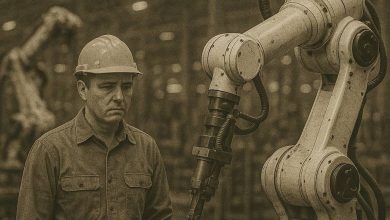
نشر رجلُ الأعمال المصريّ أحمد أبو هشيمة عبر حسابه الرسمي على منصة LinkedIn “لازم تعرف إن الذكاء الاصطناعي مبقاش مستقبل، هو حاضر واللي بيتأخر فيه بيتأخر كتير جدًا.” مؤكدًا أنّ التراجع والإهمال في هذا المجال يضر ّ بمعدلات الإنتاج ويؤخّر المؤسّسات

وبالاعتماد على تصريح المهندس خالد الدغيثر، المؤسّس والرئيس التنفيذي لشركة” مرافق الموحدة “والإداري في “إتقان السعودية”، أصبح الذكاء الاصطناعي لاعبًا رئيسيًا في إعادة تشكيل الوظائف داخل الشركات.

محمد مغربي- أستشاري التأمين والذكاء الاصطناعي

أوضح محمد مغربي، استشاري التأمين والذكاء الاصطناعي، أن السنوات الأخيرة شهدت ظهور وظائف لم تكن موجودة قبل عقد، مثل Prompt Engineer وAI Trainer، والتي تُعنى بتدريب النماذج وكتابة الأوامر للحصول على نتائج دقيقة. ولفت إلى أن الذكاء الاصطناعي لم يكتفِ بتحسين مهام تقليدية كالتسويق وخدمة العملاء، بل أوجد وظائف جديدة كليًا مثل مهندس تعلم الآلة، عالم البيانات، مدير منتج الذكاء الاصطناعي، وأخصائي أخلاقيات الذكاء الاصطناعي.

وأشار مغربي إلى تخصصات حديثة مثل Explainable AI وAI Governance، تعكس التركيز المتزايد على الشفافية والمسؤولية، مؤكدًا أن قطاعات التكنولوجيا، الصحة، المال، التعليم، والأمن السيبراني كانت الأكثر استفادة من هذه الطفرة.

كما برزت أدوار جديدة في سوق العمل مثل مصمم المحادثات الآلية، أخصائي التشغيل الآلي، ومهندس عمليات الذكاء الاصطناعي، في حين أصبح العمل الحر شائعًا في مجالات مثل الترجمة وكتابة المحتوى، مع اعتماد متزايد على المهارات الفعلية أكثر من الشهادات.

وشدّد مغربي على أهمية المزج بين الإبداع والتقنية، مشيرًا إلى تجارب مبرمجين يصممون موسيقى بالذكاء الاصطناعي ومصممي جرافيك يستخدمون أدوات مثل Midjourney وDALL·E. كما قدّم نصائح عملية للراغبين في دخول المجال، أبرزها: تعلم Python، أساسيات التعلم الآلي، أدوات تحليل البيانات مثل SQL وPower BI، واستخدام أدوات مثل ChatGPT وCopilot، مع التركيز على التفكير النقدي وفهم أخلاقيات الذكاء الاصطناعي.

وأكد أن وظائف مثل Prompt Engineer ستشهد تطورًا كبيرًا في المستقبل، محذرًا من الاعتماد الكامل على أداة واحدة، ومشددًا على أهمية بناء أساس متين من المهارات التحليلية وفهم الأنظمة. وختم بدعوة الشباب إلى البدء الآن، تنفيذ مشاريع بسيطة، والانخراط في مجتمعات تقنية لدعم التعلم المستمر.

د. رضوى عبد اللطيف – أستاذة الإعلام الرقمي

فيما تؤكد الدكتورة رضوى عبد اللطيف، أستاذة الإعلام الرقمي، أن “مفيش حاجة اسمها مهن صحفية جديدة، الصحفي هو الصحفي”، تشير إلى أن التغير الحقيقي يكمن في تطور المهام داخل المؤسسات الإعلامية التي تعتمد على تقنيات الذكاء الاصطناعي. وتوضح أن الصحفي اليوم مطالب بإجادة إنتاج المحتوى ونشره وتسويقه، إلى جانب فهم سلوك الجمهور والتحقق من دقة المعلومات باستخدام أدوات الذكاء الاصطناعي.

وترى عبد اللطيف أن الدور الإنساني للصحفي لا يمكن استبداله، بل يُستكمل من خلال مجموعة من الأدوات الحديثة مثل برامج التحرير والتصحيح اللغوي، الترجمة الآلية، التسويق الرقمي، تخصيص المحتوى، وتحليل سلوك الجمهور. وتلفت إلى أن هذه التقنيات أسهمت في نشوء وظائف جديدة في المجال الإعلامي، من بينها محلل بيانات الجمهور، خبير تحليل التوجهات، صحفي البيانات التحليلية، مصمم المحتوى التفاعلي، ومدير الحملات الرقمية، مؤكدة على ضرورة الإبقاء على الرقابة البشرية والالتزام بالقيم المهنية لضمان نزاهة العمل الصحفي

    خالد الشربيني – مستشار استراتيجي وخبير موارد بشرية

    أكد خالد الشربيني، المستشار الاستراتيجي وخبير الموارد البشرية، أن الذكاء الاصطناعي أصبح ضرورة ملحّة في سوق العمل، مستشهدًا بتقرير Veritone لعام 2024، الذي أشار إلى زيادة وظائف الذكاء الاصطناعي في الولايات المتحدة بنسبة 24.5% مقارنة بعام 2023، بما يعادل أكثر من 81 ألف وظيفة جديدة.

    وأوضح أن الشركات تبحث عن مهارات متخصصة مثل تحليل البيانات، البرمجة (Python، Java)، الأمن السيبراني، التعلم الآلي، والهندسة التفاعلية، مؤكدًا أن 87% من المؤسسات باتت تستخدم الذكاء الاصطناعي في التوظيف، عبر أدوات مثل فرز السير الذاتية والمقابلات الذكية.

    وأشار الشربيني إلى توسع قطاعات مثل الرعاية الصحية، المال، التسويق الرقمي، والخدمات اللوجستية بفضل هذه التقنيات، لافتًا إلى أن المنتدى الاقتصادي العالمي يتوقع خلق 170 مليون وظيفة جديدة بحلول 2030. كما كشف أن 77% من الشركات تخطط لإعادة تأهيل موظفيها عبر تدريبات وشهادات مهنية، مؤكدًا على أهمية دور “قادة التحول” في دمج التكنولوجيا داخل بيئات العمل.

    وختم بدعوة الشباب إلى تطوير مهاراتهم التقنية والشخصية، وتبنّي التعلم المستمر، مشددًا على أن الذكاء الاصطناعي لا يُغني عن الإنسان، بل يدعمه ويعزز جودة القرارات والخدمات.

    يتضح جليًا من خلال تصريحات أحمد أبو هشيمة وخبراء المجال أن الذكاء الاصطناعي لم يعد خيارًا مستقبليًا بل ضرورة حاضرة تتطلب انتباه المؤسسات والأفراد على حد سواء، وإلا فقدوا فرصًا كبيرة في التطور والابتكار. وقد كشفت هذه الحوارات عن تنوع الأدوار والمهام التي نشأت مع اعتماد تقنيات الذكاء الاصطناعي، بدءًا من تحليل البيانات وتصميم النماذج وصولًا إلى إدارة الحملات الرقمية وإثراء المحتوى الصحفي، مع التأكيد الدائم على أهمية العنصر البشري والرقابة الإنسانية لضمان جودة الأداء والحفاظ على القيم المهنية.

    يبقى الاستثمار في بناء المهارات الأساسية والتخصصية، وتبني ثقافة التعلم المستمر، هو السبيل الأمثل لمواجهة تحديات التحول الرقمي واغتنام فرصه المتجددة. ومن خلال تعاون القادة وصناع القرار مع كوادرهم على تأهيل بيئات العمل وتبني أدوات الذكاء الاصطناعي بوعي ومسؤولية، يمكن للمؤسسات أن تصنع طريقها نحو مستقبلٍ أكثر إنتاجية واستدامة


     

    اظهر المزيد

    مقالات ذات صلة

    زر الذهاب إلى الأعلى