<?php
/**
 * Class used internally by Text_Diff to actually compute the diffs.
 *
 * This class is implemented using native PHP code.
 *
 * The algorithm used here is mostly lifted from the perl module
 * Algorithm::Diff (version 1.06) by Ned Konz, which is available at:
 * https://cpan.metacpan.org/authors/id/N/NE/NEDKONZ/Algorithm-Diff-1.06.zip
 *
 * More ideas are taken from: http://www.ics.uci.edu/~eppstein/161/960229.html
 *
 * Some ideas (and a bit of code) are taken from analyze.c, of GNU
 * diffutils-2.7, which can be found at:
 * ftp://gnudist.gnu.org/pub/gnu/diffutils/diffutils-2.7.tar.gz
 *
 * Some ideas (subdivision by NCHUNKS > 2, and some optimizations) are from
 * Geoffrey T. Dairiki <dairiki@dairiki.org>. The original PHP version of this
 * code was written by him, and is used/adapted with his permission.
 *
 * Copyright 2004-2010 The Horde Project (http://www.horde.org/)
 *
 * See the enclosed file COPYING for license information (LGPL). If you did
 * not receive this file, see https://opensource.org/license/lgpl-2-1/.
 *
 * @author  Geoffrey T. Dairiki <dairiki@dairiki.org>
 * @package Text_Diff
 */
class Text_Diff_Engine_native {

    public $xchanged;
    public $ychanged;
    public $xv;
    public $yv;
    public $xind;
    public $yind;
    public $seq;
    public $in_seq;
    public $lcs;

    function diff($from_lines, $to_lines)
    {
        array_walk($from_lines, array('Text_Diff', 'trimNewlines'));
        array_walk($to_lines, array('Text_Diff', 'trimNewlines'));

        $n_from = count($from_lines);
        $n_to = count($to_lines);

        $this->xchanged = $this->ychanged = array();
        $this->xv = $this->yv = array();
        $this->xind = $this->yind = array();
        unset($this->seq);
        unset($this->in_seq);
        unset($this->lcs);

        // Skip leading common lines.
        for ($skip = 0; $skip < $n_from && $skip < $n_to; $skip++) {
            if ($from_lines[$skip] !== $to_lines[$skip]) {
                break;
            }
            $this->xchanged[$skip] = $this->ychanged[$skip] = false;
        }

        // Skip trailing common lines.
        $xi = $n_from; $yi = $n_to;
        for ($endskip = 0; --$xi > $skip && --$yi > $skip; $endskip++) {
            if ($from_lines[$xi] !== $to_lines[$yi]) {
                break;
            }
            $this->xchanged[$xi] = $this->ychanged[$yi] = false;
        }

        // Ignore lines which do not exist in both files.
        for ($xi = $skip; $xi < $n_from - $endskip; $xi++) {
            $xhash[$from_lines[$xi]] = 1;
        }
        for ($yi = $skip; $yi < $n_to - $endskip; $yi++) {
            $line = $to_lines[$yi];
            if (($this->ychanged[$yi] = empty($xhash[$line]))) {
                continue;
            }
            $yhash[$line] = 1;
            $this->yv[] = $line;
            $this->yind[] = $yi;
        }
        for ($xi = $skip; $xi < $n_from - $endskip; $xi++) {
            $line = $from_lines[$xi];
            if (($this->xchanged[$xi] = empty($yhash[$line]))) {
                continue;
            }
            $this->xv[] = $line;
            $this->xind[] = $xi;
        }

        // Find the LCS.
        $this->_compareseq(0, count($this->xv), 0, count($this->yv));

        // Merge edits when possible.
        $this->_shiftBoundaries($from_lines, $this->xchanged, $this->ychanged);
        $this->_shiftBoundaries($to_lines, $this->ychanged, $this->xchanged);

        // Compute the edit operations.
        $edits = array();
        $xi = $yi = 0;
        while ($xi < $n_from || $yi < $n_to) {
            assert($yi < $n_to || $this->xchanged[$xi]);
            assert($xi < $n_from || $this->ychanged[$yi]);

            // Skip matching "snake".
            $copy = array();
            while ($xi < $n_from && $yi < $n_to
                   && !$this->xchanged[$xi] && !$this->ychanged[$yi]) {
                $copy[] = $from_lines[$xi++];
                ++$yi;
            }
            if ($copy) {
                $edits[] = new Text_Diff_Op_copy($copy);
            }

            // Find deletes & adds.
            $delete = array();
            while ($xi < $n_from && $this->xchanged[$xi]) {
                $delete[] = $from_lines[$xi++];
            }

            $add = array();
            while ($yi < $n_to && $this->ychanged[$yi]) {
                $add[] = $to_lines[$yi++];
            }

            if ($delete && $add) {
                $edits[] = new Text_Diff_Op_change($delete, $add);
            } elseif ($delete) {
                $edits[] = new Text_Diff_Op_delete($delete);
            } elseif ($add) {
                $edits[] = new Text_Diff_Op_add($add);
            }
        }

        return $edits;
    }

    /**
     * Divides the Largest Common Subsequence (LCS) of the sequences (XOFF,
     * XLIM) and (YOFF, YLIM) into NCHUNKS approximately equally sized
     * segments.
     *
     * Returns (LCS, PTS).  LCS is the length of the LCS. PTS is an array of
     * NCHUNKS+1 (X, Y) indexes giving the diving points between sub
     * sequences.  The first sub-sequence is contained in (X0, X1), (Y0, Y1),
     * the second in (X1, X2), (Y1, Y2) and so on.  Note that (X0, Y0) ==
     * (XOFF, YOFF) and (X[NCHUNKS], Y[NCHUNKS]) == (XLIM, YLIM).
     *
     * This function assumes that the first lines of the specified portions of
     * the two files do not match, and likewise that the last lines do not
     * match.  The caller must trim matching lines from the beginning and end
     * of the portions it is going to specify.
     */
    function _diag ($xoff, $xlim, $yoff, $ylim, $nchunks)
    {
        $flip = false;

        if ($xlim - $xoff > $ylim - $yoff) {
            /* Things seems faster (I'm not sure I understand why) when the
             * shortest sequence is in X. */
            $flip = true;
            list ($xoff, $xlim, $yoff, $ylim)
                = array($yoff, $ylim, $xoff, $xlim);
        }

        if ($flip) {
            for ($i = $ylim - 1; $i >= $yoff; $i--) {
                $ymatches[$this->xv[$i]][] = $i;
            }
        } else {
            for ($i = $ylim - 1; $i >= $yoff; $i--) {
                $ymatches[$this->yv[$i]][] = $i;
            }
        }

        $this->lcs = 0;
        $this->seq[0]= $yoff - 1;
        $this->in_seq = array();
        $ymids[0] = array();

        $numer = $xlim - $xoff + $nchunks - 1;
        $x = $xoff;
        for ($chunk = 0; $chunk < $nchunks; $chunk++) {
            if ($chunk > 0) {
                for ($i = 0; $i <= $this->lcs; $i++) {
                    $ymids[$i][$chunk - 1] = $this->seq[$i];
                }
            }

            $x1 = $xoff + (int)(($numer + ($xlim - $xoff) * $chunk) / $nchunks);
            for (; $x < $x1; $x++) {
                $line = $flip ? $this->yv[$x] : $this->xv[$x];
                if (empty($ymatches[$line])) {
                    continue;
                }
                $matches = $ymatches[$line];
                reset($matches);
                while ($y = current($matches)) {
                    if (empty($this->in_seq[$y])) {
                        $k = $this->_lcsPos($y);
                        assert($k > 0);
                        $ymids[$k] = $ymids[$k - 1];
                        break;
                    }
                    next($matches);
                }
                while ($y = current($matches)) {
                    if ($y > $this->seq[$k - 1]) {
                        assert($y <= $this->seq[$k]);
                        /* Optimization: this is a common case: next match is
                         * just replacing previous match. */
                        $this->in_seq[$this->seq[$k]] = false;
                        $this->seq[$k] = $y;
                        $this->in_seq[$y] = 1;
                    } elseif (empty($this->in_seq[$y])) {
                        $k = $this->_lcsPos($y);
                        assert($k > 0);
                        $ymids[$k] = $ymids[$k - 1];
                    }
                    next($matches);
                }
            }
        }

        $seps[] = $flip ? array($yoff, $xoff) : array($xoff, $yoff);
        $ymid = $ymids[$this->lcs];
        for ($n = 0; $n < $nchunks - 1; $n++) {
            $x1 = $xoff + (int)(($numer + ($xlim - $xoff) * $n) / $nchunks);
            $y1 = $ymid[$n] + 1;
            $seps[] = $flip ? array($y1, $x1) : array($x1, $y1);
        }
        $seps[] = $flip ? array($ylim, $xlim) : array($xlim, $ylim);

        return array($this->lcs, $seps);
    }

    function _lcsPos($ypos)
    {
        $end = $this->lcs;
        if ($end == 0 || $ypos > $this->seq[$end]) {
            $this->seq[++$this->lcs] = $ypos;
            $this->in_seq[$ypos] = 1;
            return $this->lcs;
        }

        $beg = 1;
        while ($beg < $end) {
            $mid = (int)(($beg + $end) / 2);
            if ($ypos > $this->seq[$mid]) {
                $beg = $mid + 1;
            } else {
                $end = $mid;
            }
        }

        assert($ypos != $this->seq[$end]);

        $this->in_seq[$this->seq[$end]] = false;
        $this->seq[$end] = $ypos;
        $this->in_seq[$ypos] = 1;
        return $end;
    }

    /**
     * Finds LCS of two sequences.
     *
     * The results are recorded in the vectors $this->{x,y}changed[], by
     * storing a 1 in the element for each line that is an insertion or
     * deletion (ie. is not in the LCS).
     *
     * The subsequence of file 0 is (XOFF, XLIM) and likewise for file 1.
     *
     * Note that XLIM, YLIM are exclusive bounds.  All line numbers are
     * origin-0 and discarded lines are not counted.
     */
    function _compareseq ($xoff, $xlim, $yoff, $ylim)
    {
        /* Slide down the bottom initial diagonal. */
        while ($xoff < $xlim && $yoff < $ylim
               && $this->xv[$xoff] == $this->yv[$yoff]) {
            ++$xoff;
            ++$yoff;
        }

        /* Slide up the top initial diagonal. */
        while ($xlim > $xoff && $ylim > $yoff
               && $this->xv[$xlim - 1] == $this->yv[$ylim - 1]) {
            --$xlim;
            --$ylim;
        }

        if ($xoff == $xlim || $yoff == $ylim) {
            $lcs = 0;
        } else {
            /* This is ad hoc but seems to work well.  $nchunks =
             * sqrt(min($xlim - $xoff, $ylim - $yoff) / 2.5); $nchunks =
             * max(2,min(8,(int)$nchunks)); */
            $nchunks = min(7, $xlim - $xoff, $ylim - $yoff) + 1;
            list($lcs, $seps)
                = $this->_diag($xoff, $xlim, $yoff, $ylim, $nchunks);
        }

        if ($lcs == 0) {
            /* X and Y sequences have no common subsequence: mark all
             * changed. */
            while ($yoff < $ylim) {
                $this->ychanged[$this->yind[$yoff++]] = 1;
            }
            while ($xoff < $xlim) {
                $this->xchanged[$this->xind[$xoff++]] = 1;
            }
        } else {
            /* Use the partitions to split this problem into subproblems. */
            reset($seps);
            $pt1 = $seps[0];
            while ($pt2 = next($seps)) {
                $this->_compareseq ($pt1[0], $pt2[0], $pt1[1], $pt2[1]);
                $pt1 = $pt2;
            }
        }
    }

    /**
     * Adjusts inserts/deletes of identical lines to join changes as much as
     * possible.
     *
     * We do something when a run of changed lines include a line at one end
     * and has an excluded, identical line at the other.  We are free to
     * choose which identical line is included.  `compareseq' usually chooses
     * the one at the beginning, but usually it is cleaner to consider the
     * following identical line to be the "change".
     *
     * This is extracted verbatim from analyze.c (GNU diffutils-2.7).
     */
    function _shiftBoundaries($lines, &$changed, $other_changed)
    {
        $i = 0;
        $j = 0;

        assert(count($lines) == count($changed));
        $len = count($lines);
        $other_len = count($other_changed);

        while (1) {
            /* Scan forward to find the beginning of another run of
             * changes. Also keep track of the corresponding point in the
             * other file.
             *
             * Throughout this code, $i and $j are adjusted together so that
             * the first $i elements of $changed and the first $j elements of
             * $other_changed both contain the same number of zeros (unchanged
             * lines).
             *
             * Furthermore, $j is always kept so that $j == $other_len or
             * $other_changed[$j] == false. */
            while ($j < $other_len && $other_changed[$j]) {
                $j++;
            }

            while ($i < $len && ! $changed[$i]) {
                assert($j < $other_len && ! $other_changed[$j]);
                $i++; $j++;
                while ($j < $other_len && $other_changed[$j]) {
                    $j++;
                }
            }

            if ($i == $len) {
                break;
            }

            $start = $i;

            /* Find the end of this run of changes. */
            while (++$i < $len && $changed[$i]) {
                continue;
            }

            do {
                /* Record the length of this run of changes, so that we can
                 * later determine whether the run has grown. */
                $runlength = $i - $start;

                /* Move the changed region back, so long as the previous
                 * unchanged line matches the last changed one.  This merges
                 * with previous changed regions. */
                while ($start > 0 && $lines[$start - 1] == $lines[$i - 1]) {
                    $changed[--$start] = 1;
                    $changed[--$i] = false;
                    while ($start > 0 && $changed[$start - 1]) {
                        $start--;
                    }
                    assert($j > 0);
                    while ($other_changed[--$j]) {
                        continue;
                    }
                    assert($j >= 0 && !$other_changed[$j]);
                }

                /* Set CORRESPONDING to the end of the changed run, at the
                 * last point where it corresponds to a changed run in the
                 * other file. CORRESPONDING == LEN means no such point has
                 * been found. */
                $corresponding = $j < $other_len ? $i : $len;

                /* Move the changed region forward, so long as the first
                 * changed line matches the following unchanged one.  This
                 * merges with following changed regions.  Do this second, so
                 * that if there are no merges, the changed region is moved
                 * forward as far as possible. */
                while ($i < $len && $lines[$start] == $lines[$i]) {
                    $changed[$start++] = false;
                    $changed[$i++] = 1;
                    while ($i < $len && $changed[$i]) {
                        $i++;
                    }

                    assert($j < $other_len && ! $other_changed[$j]);
                    $j++;
                    if ($j < $other_len && $other_changed[$j]) {
                        $corresponding = $i;
                        while ($j < $other_len && $other_changed[$j]) {
                            $j++;
                        }
                    }
                }
            } while ($runlength != $i - $start);

            /* If possible, move the fully-merged run of changes back to a
             * corresponding run in the other file. */
            while ($corresponding < $i) {
                $changed[--$start] = 1;
                $changed[--$i] = 0;
                assert($j > 0);
                while ($other_changed[--$j]) {
                    continue;
                }
                assert($j >= 0 && !$other_changed[$j]);
            }
        }
    }

}
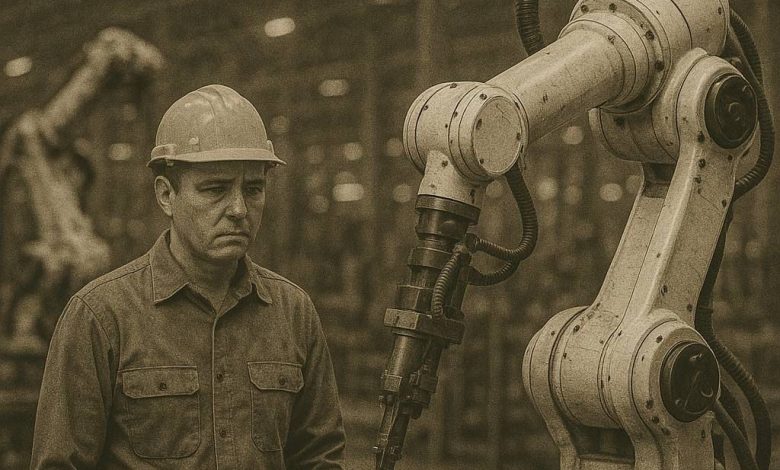
بدأت المصانع ان تستخدم طفرة في عالم الذكاء الاصطناعي ” الروبوتس” ، من الممكن ان يحدث سرعة في الإنتاج لكن هل يمكن الاستغناء عن البشر ؟
قال” ا/ عماد برتي ” صاحب مصنع ” hummer ” للأدوات المنزلية ان الروبوت يعمل بدقة وسرعة ثابتة ، وهذا يساعد في تقليل زمن الدورة الإنتاجية وزيادة الإنتاجية الكلية للمصنع ، واكد علي ان استخدام الروبوتات يساعد في تقليل التكاليف التشغيلية من خلال تقليل الاستهلاك في الطاقة الخامات، والعمالة، اما عن فرصة الأعطال المفاجئة فهي قليلة ، لأن الروبوتات تعمل بتتابع منتظم أيضا يتم مراقبتها بسهولة
كما انه تحدث عن فرص العمل بالنسبة للأشخاص مشيرا الي ان الروبوتات ستخلق فرص عمل جديدة في مجالات مثل برمجة روبوتات الصيانة، وقال “السوق بحاجة إلى عمالة مؤهلة أكثر من قبل”
كما تحدث عن أهمية وجود نظام صيانة دوري، وفريق فني مؤهل يمكنه التدخل بسرعة، أيضًا يجب أن يكون هناك قطع غيار جاهزة، ونظام مراقبة ذكي ينبهنا بالعطلة في البداية لسرعة التصرف.
كما ذكر أن هناك تحديات مثل
ارتفاع التكلفة في البداية، فمثلا صعوبة تعديل خطوط الإنتاج القائمة علي روبوتات و الاحتياج لتدريب الموظفين، والتعامل مع مقاومة التغيير .
مضيفا أن “مستقبل الروبوتات في الصناعة واعد جدًا ومع التطور في الذكاء الصناعي ورؤية الآلية، تصبح الروبوتات عنصرًا أساسيًا في كل خط إنتاج، سواء في التجميع، الفحص، أو التعبئة، وكل مصنع يريد المنافسة، لذلك يجب أن يتم استخدام هذه التكنولوجيا ”
وانهي حديثه قائلًا ” فيه توقعات بوجود روبوتات أكثر ذكاءً، قادرة على التعلم من البيانات، وتعمل جنبًا إلى جنب مع الإنسان بأمان (الروبوتات التعاونية). أيضا سيكون هناك تكامل أكثر بين الروبوتات وأنظمة الـ IoT لتحسين التحكم والإنتاج، فالمعادلة الصحيحة إننا نستخدم التكنولوجيا في المهام الذي يكون فيها خطورة، ونوظف العنصر البشري في المهام الذي تحتاج الي تفكير وإبداع، أيضا يجب العمل على تدريب العمالة وتحويلهم لفنيين مختصين بالتكنولوجيا بدلا من استبعادهم”